
ODM Jewelry Manufacturing for Boutique Labels
A boutique label usually arrives without a CAD department and with a clear idea of how a piece should feel. ODM is built for that gap: the buyer supplies the inspiration, the factory develops the concept into a model, and the collection stays exclusive to the brand. TTT Jewelry publishes the practical frame around that promise, from 48-hour CAD to 25–30 day sampling and MOQs of 50 pieces in silver, 100 in brass and 100+ in stainless.
Key takeaways
- Six customisation levers are published for a single order, from base material to packaging.
- A 50-piece silver MOQ means six designs commit 300 pieces; the same six in brass commit 600.
- CAD is returned in under 48 hours, then sampling runs 25–30 days and production 3–4 weeks.
- ISO 9001:2015 governs process control, while BSCI and REACH address labour and material compliance.
What ODM asks of a boutique label
ODM is not a catalogue order with a logo added. The published description is you inspire, we create, which places a real obligation on the buyer: the inspiration has to be specific enough to develop. A single photograph of a vintage pendant gives a factory a direction. A sentence about quiet luxury gives it nothing to model. An OEM/ODM supplier with an in-house development bench will usually replace the vague sentence with three or four concrete questions about metal, scale and wear occasion.
Useful inputs are a reference set of five to ten images, a note on the customer and price position, the metal the label wants to be known for, and the number of pieces the range needs. The factory can then propose shapes, proportions and a finish schedule rather than guessing at taste.
The second obligation is decision speed. Each review round sits inside a 25–30 day sampling window, and a label that takes a week to comment on a model is spending the factory's calendar as well as its own. Boutique teams are small, so naming one approver with authority to sign off is more valuable than a committee.
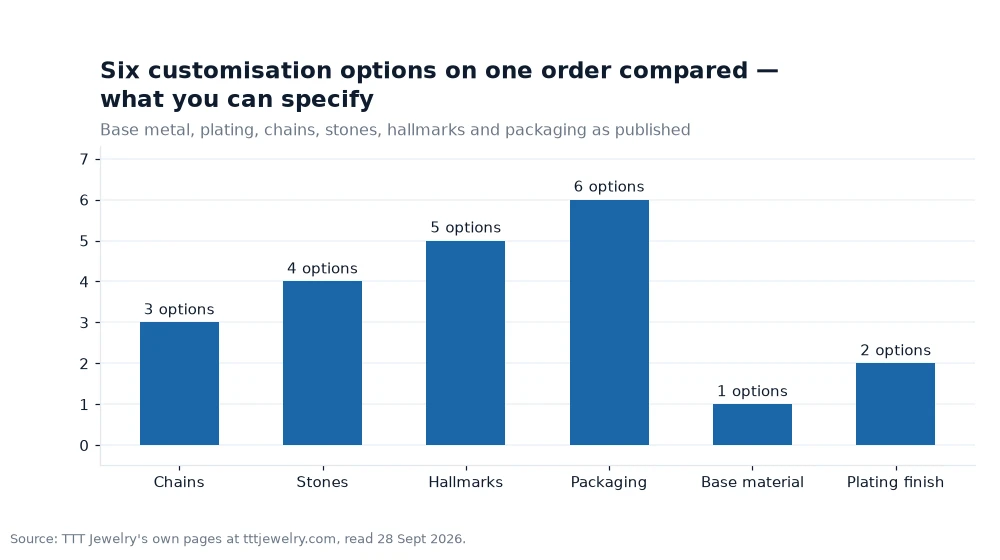
Six levers on one order
Customisation is often described as if it were a single switch. In practice it is six separate specifications, and each one can be set independently on the same order.
| Lever | What can be specified | Why it matters to a small label |
|---|---|---|
| Base material | 925 sterling silver, artisan eco-brass, stainless steel | Sets the MOQ and the wear story |
| Plating and finish | Multi-layer 14K, 18K or 24K gold, rhodium, anti-tarnish e-coat, PVD on stainless | Drives colour, tarnish resistance and cost |
| Chains and findings | Chain style, length, clasp type, earring backs | Determines how the piece sits and wears |
| Stones and accents | Natural stones, freshwater pearls, CZ, turquoise, birthstones | Creates the range architecture |
| Logo and hallmarks | Laser engraving, S925, 316L, 18KGP marks | Turns a piece into branded stock |
| Packaging | Metallic tags, foil-stamped boxes, velvet or microfiber pouches, backing cards, barcode labels | Delivers retail-ready units |
The packaging row surprises first-time buyers most. A pouch and a backing card are not accessories added at the end; they are part of the unit that reaches the customer, and they need to be specified before production because barcode labels and backing cards are printed in a separate run.
Hallmarks deserve the same attention. A laser-engraved S925 mark on a silver piece is a legal statement about the alloy, not a decorative flourish. Getting the mark wrong on 300 pieces is a rework problem, not a design preference.
Building a first collection around MOQ
Minimums are per design, which is the detail that shapes a debut range. Silver at 50 pieces per design means a six-piece collection commits 300 units. Brass at 100 pieces per design means the same six shapes commit 600. Stainless at 100+ means the floor is higher still and should be confirmed before the range is locked.
Most boutique labels handle this by mixing. Three silver designs at 50 pieces is 150 units; three brass designs at 100 pieces is 300; the collection totals 450 pieces across two metals and two price points. That structure gives the range a hero tier and an entry tier without doubling the design count.
The metal mix also changes the finish conversation. Silver and brass take multi-layer gold plating with an anti-tarnish e-coat; stainless takes PVD vacuum plating. A label that wants one visual finish across three metals is asking for three different processes to land on the same colour, which is achievable within a tolerance but never identical. Buyers who want to test that claim before committing should look at how a China OEM jewelry manufacturer writes the finish specification, because the document is where the three processes are separated.
Concept development, then exclusivity
The development flow has six published steps: inquiry, consultation and development, CAD and prototype, sample and approval, bulk production, and final QC and delivery. For an ODM label the second step is the heaviest, because it converts inspiration into a brief that a model can be built from.
CAD follows in under 48 hours. That speed is useful mainly as a feedback loop: the label sees a shape early, before metal is committed. Sampling then takes 25–30 days, and production 3–4 weeks. Across the full route, 2 + 25 to 30 + 21 to 28 = 48 to 60 days.
Exclusivity is the other half of the ODM offer. The published position is that designs are 100% exclusive, with moulds, CAD and the collection not resold or shown. For a boutique label this is the difference between a manufacturer and a wholesaler of its own look, and it should be confirmed in the order documentation rather than inferred from a conversation.
Worked example
Price the metal mix, not the collection. Six silver designs at the 50-piece minimum is 6 × 50 = 300 units. Six brass designs at the 100-piece minimum is 6 × 100 = 600 units. A split of three and three is 3 × 50 + 3 × 100 = 150 + 300 = 450 units.
Now compare the design cost per unit. Three silver designs share the development effort across 150 pieces, or 50 pieces per design. Three brass designs share it across 300 pieces, or 100 pieces per design. The brass tier spreads the same fixed development work over twice as many units, which is why entry-price ranges tend to be brass and hero pieces tend to be silver.
On timing, a single sampling round adds 25 to 30 days to the 2-day CAD step and the 21–28 day production run, giving 48 to 60 days. Two rounds push the ceiling to 2 + 30 + 30 + 28 = 90 days, so a launch plan should reserve the second round rather than discover it.
Frequently asked questions
Can a boutique label order six designs at once?
Yes, and the minimum applies per design: six silver designs commit 300 pieces, while six brass designs commit 600.
Does ODM include the brand's logo on the piece?
Yes, laser engraving is published as a customisation option, with marks such as S925, 316L or 18KGP applied according to the base metal.
How long before a debut collection ships?
Allow 48 to 60 days from approved brief to dispatch, covering under 48 hours of CAD, 25 to 30 days of sampling and 3 to 4 weeks of production.
Getting a first range to retail
Start with the range architecture, then choose metals to fit it, then confirm the finish schedule. That order keeps MOQ from dictating design, which is the usual failure mode for a first collection.
It also helps to work with a supplier that publishes its thresholds rather than negotiating them per enquiry. TTT Jewelry lists its material minimums and its sampling windows openly, which makes the first budget conversation shorter.
For labels planning to scale after the debut, the custom jewelry wholesale route keeps the same design language while moving into repeat ordering, where the second run no longer carries a first-run learning curve.
Source note: figures come from the manufacturer's own website (tttjewelry.com), read 28 Sept 2026.[1]