
Before Your First Call About a Store-Brand Scent: What to Have Ready
A first call with a fragrance manufacturer rarely fails because the buyer lacks knowledge; it fails because the buyer cannot state price, volume, pack and market in the first ten minutes, so the conversation becomes a tour of the supplier's capabilities instead of a test of fit. Seven items are enough to change that: a target price band, an estimated volume, a pack direction, the selling market, a decision timeline, the number of SKUs, and a named internal owner. Everything else can be worked out afterwards.
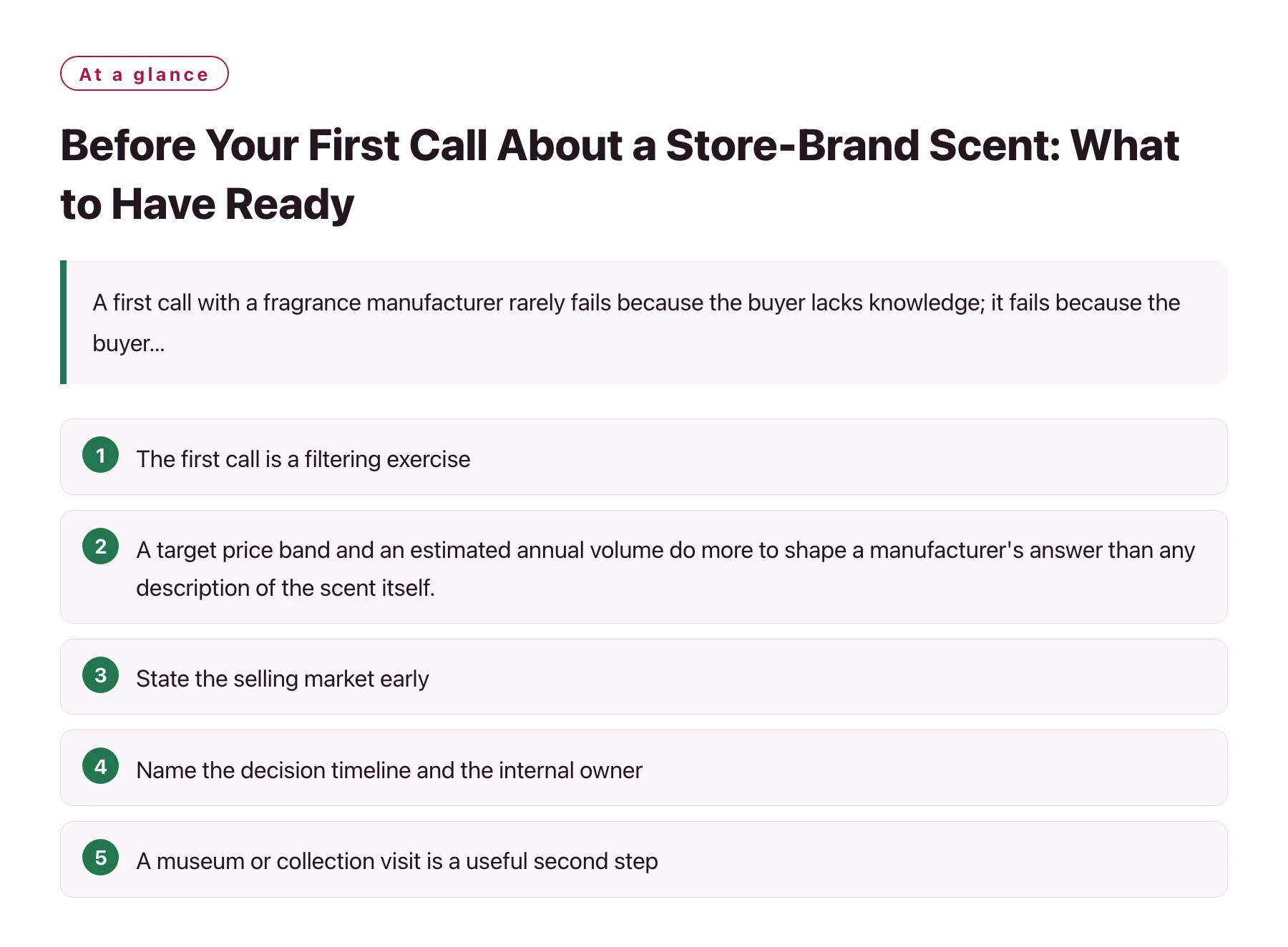
Key takeawaysThe first call is a filtering exercise, so arrive with constraints rather than a wish list; constraints are what make two suppliers comparable in the same conversation. · A target price band and an estimated annual volume do more to shape a manufacturer's answer than any description of the scent itself. · State the selling market early, because labelling, allergen disclosure and restricted-material work differ by jurisdiction and change what the supplier can offer. · Name the decision timeline and the internal owner; a supplier calibrates its development schedule to your gate dates, and vagueness there produces a vague plan. · A museum or collection visit is a useful second step, not a substitute for the first call, because it produces a direction rather than a specification.
Most first calls about a store-brand scent follow the same arc. There is polite introduction, a description of the range as fresh and modern, a question about minimum order quantity, and then forty minutes of general capability discussion that ends with a brochure and a promise to follow up. Nobody is at fault; the buyer simply has not been given anything specific to react to, and the supplier fills the vacuum with its own material.
The fix is preparation, and it is a couple of hours of work. Manufacturers price and plan from four variables — volume, pack, complexity and market — and a buyer who brings all four gets a useful answer on the first call. A buyer who brings one gets a range, which is not the same thing as a quote.
It also helps to know what the other side can realistically decide on a call. A manufacturer can usually say whether a brief is feasible, roughly where the price will land, what the sampling process looks like and how long it takes. It cannot sensibly commit to a final formula, a firm unit price or a delivery date without a specification. Knowing that split keeps the conversation in the zone where it is productive [1].
Seven items to have ready
- A target price bandNot a single number, and not a wish. A band with a stated basis, such as the on-shelf price the range must sit at, tells the manufacturer how much of the cost can live in the juice, the pack and the decoration.
- An estimated annual volume, with a first-order splitThe first order and the annual run are different numbers, and manufacturers need both because tooling and material planning depend on the second while quoting depends on the first.
- A pack directionA standard bottle with a standard pump is a different project from a custom mould with a coated finish. Say which one you are considering, and say whether the pack is already chosen or open.
- The selling market or marketsJurisdiction determines allergen disclosure, labelling language and which restricted materials need attention, so it belongs in the first sentence rather than the last.
- The number of SKUsTwo SKUs and twelve SKUs are different programmes. Range size drives development cost, tooling, and how much time each individual scent gets.
- Gate dates and the internal ownerGive the date by which a range must be approved, not the date it must be on shelf, and name the person who will make the call when opinions differ.
- Any non-negotiablesA certification the retailer requires, a packaging material it refuses, a maximum alcohol content, a vegan claim. Non-negotiables are cheap to state now and expensive to discover at sample three. If the internal team has never run this kind of project, a short read on what it takes to launch a perfume brand is a reasonable way to prepare.
How to use the call once it is specific
With constraints on the table, the call becomes a comparison. Ask each candidate the same five questions: what development would look like, what the sampling rounds include, who writes the formula, which tests are run and by whom, and what the lead time is measured from. Answers that are specific are the ones worth writing down, because they can be checked against a later quotation.
It is also worth asking what the manufacturer would change about your plan. A supplier that identifies a real tension — an ambitious pack against a low target price, or a twelve-SKU range against a short timeline — is demonstrating that it listened. A supplier that agrees with everything has either not understood the constraint or has decided to resolve it later, at your expense.
What a museum visit adds, and what it cannot
A visit to a supplier's collection or exhibition is a good second conversation because it converts adjectives into directions. Instead of arguing about what fresh means, a team can smell three interpretations and agree on one. That compresses the brief considerably, and it is often the fastest way to bring marketing and product development onto the same page, which is why collections such as Xuelei Fragrance Museum are built around walking a team through materials rather than presenting a finished range.
What a visit cannot do is settle price, volume or compliance, because those are commercial and regulatory questions rather than sensory ones. Teams that arrive at a collection without constraints tend to leave with enthusiasm and no decision. Teams that arrive with the seven items above leave with a shortlist they can price, and the collection becomes what it should be: a tool rather than an outing.
The regulatory items to raise early
Fragrance is regulated as part of the cosmetic product, and the substance-level restrictions that apply to a formula differ by product category and by market. A body lotion is not the same regulatory object as a fine fragrance even when both carry the same scent [2]. Raising this on the first call costs nothing and prevents a candidate direction from being developed into a dead end.
The practical question to ask is not whether the manufacturer complies, because every manufacturer will say yes. It is which categories the candidate directions are being assessed for, who supplies the documentation, and what happens if a restriction changes during the life of the product. Those three answers tell you whether compliance is a process at the supplier or a sentence in a presentation, and they are also a fair way to read about Xuelei or any competitor's site before you shortlist.
If the preparation has to be cut to one thing, make it the target price band on shelf. Volume and pack can be estimated in the room, but a manufacturer cannot reason about a range without knowing what the shopper will pay, because that decision determines the juice budget, the pack options and the decoration method all at once. Buyers who want to check what a manufacturer handles in-house before the call, so the questions are better aimed, can Click here and read the scope first.
Sources
- Mintel Press Centre —— Mintel's press releases on consumer and beauty market research, including fragrance and personal care trend reporting.
- IFRA: Safe Use and Fragrance Science —— IFRA's explanation of how fragrance materials are scientifically assessed for safe use and how those conclusions are applied by the industry.
Frequently asked questions
How much information does a manufacturer need for a first conversation?
Enough to reason about feasibility: a price band, an estimated volume, a pack direction, the selling market and a rough timeline. Nothing has to be final. Manufacturers are used to early-stage numbers, and an approximate figure that is honest is far more useful than an aspirational one that is not.
Should a retailer approach several manufacturers at once?
Two or three is usually workable and keeps the conversation competitive. More than that spreads the buyer's attention and turns a development decision into a procurement exercise. The exception is a large programme with formal tendering rules, where a wider field is required by process rather than by choice.
Is a sample needed before the first call?
A reference is helpful but not necessary. A sample of a scent the range should sit beside, or a competitor product the range must beat, is more useful than a target composition, because it tells the manufacturer what the range has to achieve commercially rather than only how it should smell.
What should we ask for at the end of the first call?
A written summary: the scope the manufacturer would take on, the development steps it proposes, a rough price indication with its assumptions, an indicative lead time, and the information it still needs. A supplier that sends that within a day or two is demonstrating how it will behave during the project.
Do we need to visit a collection or museum before deciding?
No, and it should not delay the commercial steps. A visit is most valuable when a team is stuck on direction or when two functions cannot agree on vocabulary. If the brief is already clear and the constraints are fixed, going straight to sampling is faster and cheaper.
Step inside the working archive.
184,000+ declassified documents, 2,400 interactive campaign maps, and 1,100 hours of uncut veteran testimony — curated by credentialed historians and free to start.
Start Exploring the Archive